
PSD Group is delighted to share insights from Nabil Lodey, an experienced SME CEO with multiple exits to private equity and strategic buyers, and a leader with UK military and defence prime experience. His expertise is in the application of dual-use defence capability to non-defence commercial markets to accelerate growth. With a background that also includes UK military service and roles within defence primes, Nabil has a full-spectrum approach to the defence innovation ecosystem.
Who Fund’s the Future of Defence?
In the context of one of the largest post-Cold War uplifts in defence spending, the Ministry of Defence (MOD) is increasingly focused on leveraging small and medium-sized enterprises (SMEs), recently described as the “…the backbone of UK defence” (Minister for Defence Readiness and Industry, Luke Pollard MP), to drive innovation, resilience and sovereign capability.
However, direct MOD expenditure with SMEs currently stands at around £1.2bn for 2024/2025, which represents roughly 4% of direct industry spend and is a significantly lower percentage compared to other Whitehall departments, highlighting persistent & systemic imbalances in the MOD procurement system.
New MOD Initiatives to Support SMEs
The MOD has now sought to address the root cause of barriers faced by SMEs through structural reforms and a range of specialised support mechanisms, such as the Defence Office for Small Business Growth (OfSBG), with an ambition to increase SME spend by an additional £2.5bn through 2028.
UK Defence Innovation is tasked to create a coherent and overarching defence innovation ecosystem within which defence SMEs can transition from solving defence and national security challenges to becoming commercially investable propositions.
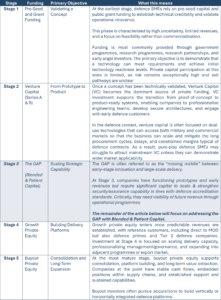
Addressing the GAP in Funding through Blended & Patient Capital
Stage 3: The GAP is the barrier to success for SMEs.
Companies have validated technology with early customer engagement but lack the scale, assurance credentials, and contract visibility required to attract conventional institutional capital. This is one of the reasons why a fully funded Defence Investment Plan is so critical to the defence sector.
To address these concerns, the GAP is (thankfully) increasingly filled by “blended & patient capital” which is a mix between “sovereign capital”, acting as a de-risking agent which then pulls though conventional investors.
Sovereign capital is the key to this blended & patient capital solution. These are strategic co-investment Government-backed vehicles, such as the NATO Innovation Fund (NIF), that are patient in nature by looking longer-term and providing funding to absorb the technical, regulatory and programme risk (including procurement, integration & assurance) that conventional investors are unwilling to carry.
By reducing risk and taking a first-loss position, sovereign fund investment allows for Private Equity (PE) and institutional investors to reduce exposure and participate at an earlier stage. Not only does this benefit the SME by bridging the GAP, but also benefits the MOD, as a customer, because PE investors also bring professionalised governance, commercial discipline and scaling expertise that enables SMEs to mature.
The Changing Model for Private Equity in Defence
A change to the traditional PE investment thesis itself is needed with investment at an earlier stage. Long procurement cycles, security/IP/assurance/export complexity, and delayed revenue recognition necessitate extended holding periods, lower leverage, flexible covenant structures, and greater operational involvement.
With a hold period at 7-10 years rather than 3-5 years, returns are going to be based on an industrial-style value creation strategy rather than rapid EBITDA enhancement alone.
Defence as a Strategic Asset Class
A functioning defence innovation ecosystem requires all five capital stages to be present and connected. When alignment fails, capability delivery slows. When it succeeds, innovation transitions into sustained operational advantage and there is no shortage of innovative SMEs in the UK ready to accept this challenge. Each and every party is involved in funding sovereign resilience.
Nabil’s perspective cuts through much of the noise in the current defence funding debate and rightly brings focus to the structural realities facing SMEs. The “GAP” he describes is not theoretical.
What is also becoming apparent is that capital alone will not solve the problem. Even with sovereign backing and a more engaged private equity community, SMEs still require clearer pathways into programmes, greater visibility of demand, and a procurement environment that enables (rather than constrains) growth. Without that, funding risks being deployed into a system that remains difficult to navigate.
The opportunity is clear. The question now is whether the system can move quickly enough, and cohesively enough, to realise it.